








Opinion Editorial October, 2026: Our Space
Opinion based on selected news stories from September 2026.
Last month, SpaceX released its third Starship documentary: "Holy Grail of Rocketry." In it the company states: "space is something for all of us." In other words, it is "our space." Around the same time, United States Air Force Secretary Troy Meink announced that the US already has on-orbit space-control weapons. Even when viewed side-by-side, those two statements contain no obvious contradiction. SpaceX's language sounds familiar because the 1967 Outer Space Treaty declares that outer space is to be explored and used for the benefit and interests of all countries.
During colonial expansion, settlers acted as though any newly "discovered" land belonged to all of them. In the American West, such people were often called pioneers as they successively "conquered" each new frontier. History teaches us the reality that indigenous people had already settled that land. Europeans appropriated it and, often, re-named it. I see that centuries-old playbook continuing today.
Lake Ontario's name has indigenous etymological roots. Indigenous peoples inhabited the region long before European colonization. But a more powerful actor (the United States) recently directed its federal government agencies to use instead the name Lake America. Symbolic authority over terminology doesn't grant legal ownership. Yet, historically, it has sometimes been the first step toward that goal. While an executive order concerning a terrestrial lake is not governed by the Outer Space Treaty, the comparison is revealing: the treaty was intended to prevent national claims from turning celestial bodies into sovereign property.
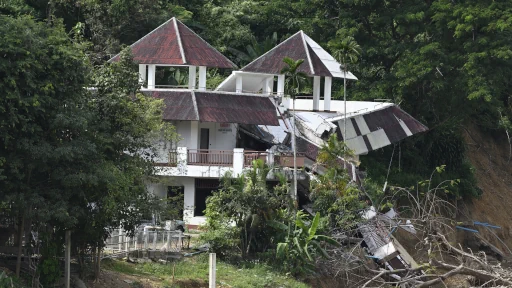
With the Eagles song "The Last Resort," Don Henley and Glenn Frey penned a stark lament for the indigenous culture and the ecology of North America that were both laid waste by European colonizers. This month's photo shows an example of the kind of environmental destruction they were writing about. I took it two years ago in northern Thailand near the Burmese border. This collapsed house sits on a bank of the Kok River. An article published last month by MGR Online International, "Kok River Ecosystem on the Brink of Collapse," cites fieldwork showing how dire the situation has now become.
The human population along the river includes indigenous peoples such as the Akha and the Lahu. They depend on the river and its basin for their livelihood. The article documents river contamination, soil erosion and their impact on local communities.
The Kok River situation is not evidence of AI's environmental impact. It is an analogy about how infrastructure and resource demands can impact communities that have little control over decision making. I think people are right to be concerned about the potential impact of water-intensive AI datacenters on aquatic ecosystems. Just a few days ago, the Goodman Group withdrew its "Project Mars" application to build a new datacenter in Sydney, Australia following local opposition.
If the environmental impact of AI isn't alarming enough, last month saw multiple warnings about the potential for its existential impact. Yet we're often told that AI will benefit all of us.
At the All-In Summit last month, Elon Musk proposed that leading AI companies vet each other's products for public safety before they are released. That got me to thinking: What would be the analogy for governments? It would allow international institutions to vet nation behavior and prevent any one country from unilaterally deciding which consequences are acceptable for the rest of the world. The common issue is: who gets to decide what risks are acceptable when the consequences extend beyond those creating those risks?
Henley and Frey imagined European colonizers eventually reaching California and declaring there was no new frontier. That would have been true at the time. But space has been a frontier since Sputnik 1 was launched in October 1957.
If space and AI are truly for all of us, they cannot be treated as just another frontier to be appropriated by the wealthy and the powerful. "For all of us" and "governed by all of us" are two very different propositions. Corporate self-regulation and unilateral government decrees are no substitute for public oversight and international cooperation.
Three days ago, SpaceX took a significant step toward its goal of lowering further the cost of access to space with Starship Flight 14. It will continue to pursue that goal. Today, SpaceX is scheduled to launch an experimental AI satellite into space for Google on its Transporter 18 rideshare mission. Things rhetorically presented as belonging to everyone could become dominated, appropriated and controlled by a small few if we repeat the mistakes of the colonial playbook. "Our space" would then become "their space."
Our opinion editorials offer an indigenous peoples perspective on current world events. They do not link to external organizatons' websites; instead we encourage our readers to do their own research. If you would like to support our model of independent journalism, please click on the link or scan the QR code below to buy us a coffee. Thanks!