



Opinion Editorial March, 2026: Shock the Monkey
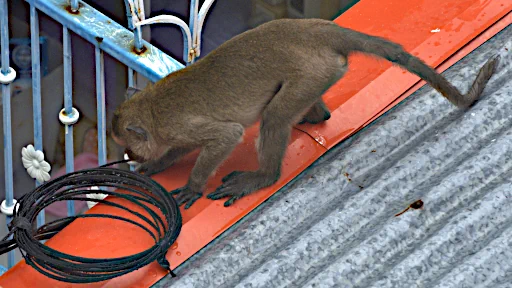
I did not shock this monkey by photographing it a few years ago in the center of the small Thai town of Hua Hin. Indeed, when it came into the town with other members of its troop and started foraging, neither I nor the locals were shocked. All the monkeys ignored us.
Nor was I shocked last month when I read a comment by a resident of the small Cornish village of Cardinham in the United Kingdom stating that she was thinking of building an ark. Her comment came after her village had experienced rain for each of the first forty-one days of this year. I spent some of those same days in that country. The stereotype is partly true — the British love to complain about the weather.
Still, I knew that her comment was only light-hearted jest. It shows that knowledge has replaced our original tendency to ascribe agency where none exists. That tendency might well have given us a survival advantage early in our evolution. But what should shock all of us is how many people still believe the literal truth of the Biblical story of the flood and the ark.
Believing such nonsense is not always harmless. In the Indian state of Jharkhand last month, an indigenous woman and her baby were burned to death. Rumors had been circulating that her practice of witchcraft was the cause of a man's illness and eventual death. A mob of vigilantes took matters into their own hands when they set her house on fire just hours after the man had died. Such stories are relatively common in tribal India where even today knowledge has still not replaced superstition.
Another mother thought her baby would die last month. In that case she is a macaque monkey at the Ichikawa City Zoo in Japan. We can't be sure why she abandoned her son, Punch. Such cases of abandonment are rare in captivity and in the wild.
Knowledge appears not to have reached the zookeepers. They gave Punch an Ikea stuffed orangutan Djungelskog toy to help comfort him. As he took to his new toy social media lit up with people not only ascribing agency to the toy but anthropomorphizing it as a surrogate mother.
The relevant science is clear on this topic. While controversial, experiments on maternal deprivation and attachment have been conducted since the 1950s — mainly using rhesus monkeys. The findings are among the most striking in all of comparative social psychology. No inanimate object can be an effective surrogate parent and lead to normal social development. Unless Punch is adopted, he will not develop normally.
The Taliban in Afghanistan were only partially detracted from their ascribing of agency to inanimate objects last month. While fighting the Pakistani military they continued to burn musical instruments due to their belief that such objects are immoral.
We are already ascribing agency to generative AI. As it continues to transform to agentic AI the danger of doing so will only increase. No wonder the monkey in this month's photo ignored humans that day. It would have been shocked only if we'd had anything of value to offer to it.
If you enjoyed reading this month's opinion editorial, please consider supporting independent, advertising-free journalism by buying us a coffee to help us cover the cost of hosting our web site. Please click on the link or scan the QR code. Thanks!